Alright, let’s cut through the jargon real quick—if you’ve hung around construction, mining, aerospace ground support, or even heavy-duty event setups, you’ve probably seen one rolling around without really putting a name to it. Let’s talk about tracked power unit crawler chassis. I’m not here to drop a bunch of industry slang that’ll make your head spin; I’m here to explain what they actually are, why they matter, and why if you’re in the market for heavy moving or power delivery, this thing is a game-changer. Power Unit Crawler Chassis

First, let’s break the name down, because that’s half the battle when you’re googling this stuff at 2 a.m. before a big project deadline. A “tracked” chassis isn’t like your average wheeled truck or skid steer—think the tank treads you see in movies, but built for way more precision than blowing stuff up. Treads spread the weight way better than wheels, so you don’t sink into muddy construction sites, soft agricultural fields, or even uneven airport tarmac that’s got rough patches. That’s the “tracked” part.
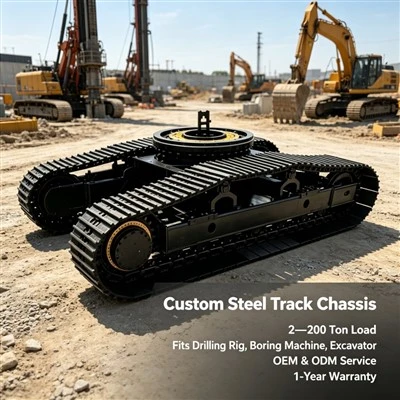
“Power unit” is the other big piece. This isn’t just a bare metal frame with treads—this chassis has its own built-in power source. No need to hook it up to an external generator or tie it to a separate engine; it’s a self-contained workhorse. For us as a supplier, that’s non-negotiable. We don’t sell half-baked frames—our tracked crawler chassis are ready to bolt on whatever attachment you need (more on that in a sec) and go, powered by their own diesel, electric, or hybrid engine, depending on your needs.
Wait, let’s make this concrete, no abstract stuff. Let’s say you’re running a mining operation in the Australian outback, where the ground is red dirt that turns to soup when it rains. A wheeled dump truck would get stuck halfway to the ore site, costing you hours of downtime and thousands in lost production. Our tracked power unit crawler chassis? It’s built for that—its treads distribute the chassis weight evenly over way more surface area, so it flotation (that’s the fancy word for not sinking) is like nothing else. Even on a slope that would make a wheeled vehicle tip, these bad boys grip hard enough to haul 10-ton loads straight up without sliding.
Or what if you’re doing event setup for a 50,000-person music festival in a park with super soft grass? You can’t drive a regular forklift over that—you’d leave ruts that take weeks to fix, not to mention getting stuck. Our crawler chassis can pull a custom forklift attachment, power all the stage lighting and sound gear, and drive over that grass without leaving a mark. That’s the utility that makes these things way more versatile than any wheeled equipment you’ll find.
Let’s clear up a common mix-up too: these aren’t the same as the tiny tracked robots you see on TikTok for gardening. Those are mini, for small jobs. Our tracked power unit crawler chassis are built for heavy-duty work—think 10 to 50 tons of capacity, depending on the model. Yeah, you read that right. We’ve got clients pulling 40-ton mining excavator attachments, powering whole construction site compressors, even moving pre-fab bathroom units to remote job sites where roads don’t exist.
What makes them different from, say, a standard crawler tractor? A standard crawler tractor is usually designed for pulling plows or heavy equipment, right? It’s built for traction, but not for being a standalone power source that you can customize on the fly. Our power unit crawler chassis are modular—we make the frame, the engine, the hydraulic system, the controls, so you can bolt on whatever you need. Want it to be a mobile generator? Sure, add a 100kW power module. Want it to pull a drill rig? We’ve got attachment points built right into the chassis frame. Want electric for zero-emission work in city construction? We build those too, no extra hassle.
Let’s talk about the stuff you don’t see, because that’s where the real value is. The undercarriage, for example—we use high-strength steel track links that are hardened to take abuse, because nobody wants to replace a track mid-job. The hydraulic system is proportional, meaning when you turn the steering, it’s smooth, not jerky. No more ramming a load into a wall because your controls are stuck. And the power source? We size them so you don’t have to overspend on extra power you don’t need, or struggle with underpowering a big load. For our clients in remote areas, we even offer auxiliary fuel tanks so they can run for 12 hours or more without refueling—no stopping mid-shift when the crew’s on a tight schedule.
Wait, let’s get personal here, because I don’t want this to sound like a sales brochure (full transparency: I work for a tracked power unit crawler chassis supplier, so I know these things inside and out). Early on, I talked to a construction client who was using a wheeled crane to lift steel beams for a bridge in British Columbia. The ground was snow-melted mud, and their crane got stuck twice in one week, costing them $15,000 a day in delays. They reached out to us, and we custom-built a mid-sized tracked power unit crawler chassis paired with a light crane attachment. It didn’t sink once, even on the worst ground, and they finished the project two days early. That’s the kind of win we live for.
Another common question: are they expensive? Yeah, upfront they cost more than a basic wheeled truck, but let’s do the math. No more getting stuck, no more downtime, no more damage to job site grounds that costs extra to repair. Our clients typically recoup the cost in 6 to 12 months, depending on how much they use it. And because they’re built to last—we warranty all our chassis for 2 years, no fine print—you won’t be dumping money into repairs every other month.
Let’s also address the “why a power unit, not just a crawler chassis” part, because that’s the key differentiator. If you just buy a crawler chassis, you have to source the engine, hydraulics, controls, all separately. That means dealing with multiple vendors, waiting for parts if something breaks, mixing parts that might not work together. We sell the whole integrated package: chassis, power source, all the controls, built to work together. It’s plug-and-play, basically. You can add attachments in an hour, not a whole day of messing with wiring and plumbing.
And for the eco-conscious folks? We’ve been getting more requests for electric tracked power unit crawler chassis lately. No emissions, so you can work in indoor construction (like building a new mall where ventilation is limited) or in national parks where diesel is banned. The electric models run for 8 hours on a single charge, and we offer fast chargers that top them up in an hour. That’s a big deal for clients who want to reduce their carbon footprint without sacrificing power or performance.
Wait, let’s bust another myth: these are only for big mining or construction. No way. We’ve got clients who use our smaller tracked power unit crawler chassis for event production, as I mentioned earlier. They power mobile stages, light rigs, even food vendor setups in parks where regular generators are too big and leave marks. We’ve also got forestry clients using them to haul logs out of steep, muddy areas where wheeled trucks can’t go. The versatility is insane—you name the heavy-duty job that requires traction, power, and adaptability, and our chassis can do it.
So when should you actually need one? Let’s run through the scenarios: if you work in areas with rough, soft, or uneven terrain, if you need a mobile power source that doesn’t rely on external utilities, if you need to use multiple attachments for different jobs without buying separate equipment, if you’re tired of downtime from getting stuck or breaking wheeled gear. That’s when a tracked power unit crawler chassis isn’t a nice-to-have—it’s a must-have.
Now, if you’re reading this and thinking “yeah, this sounds like something I could use for my next project,” don’t hesitate to reach out to us. We don’t do pushy sales calls—first, we’ll ask you about your job site, what kind of loads you’re moving, the terrain you’re working on, and your budget. Then we’ll tailor a solution, whether that’s a standard model or a custom build, no hoops to jump through. We’ve got over 10 years of experience building these things, so we know exactly what works and what doesn’t.
Don’t waste another day dealing with stuck wheeled trucks, unreliable external power sources, or equipment that’s too one-size-fits-all. A tracked power unit crawler chassis is the workhorse that’ll keep your project moving, no matter what the job throws at you. Get in touch with our team to chat through your needs and get a quote that fits your budget.
Crawler Chassis References:
- Heavy Equipment Manufacturers Association. (2022). Crawler Chassis Design Specifications for Off-Highway Applications. HEMA Technical Bulletin.
- International Organization for Standardization. (2021). Off-road Machinery – Tracked Undercarriage Performance Standards. ISO 17574:2021.
- Global Construction Viewpoint. (2023). Tracked Power Unit Adoption Rates in Remote Construction and Mining Sites. GC Research Report.
- Electric Off-Road Equipment Alliance. (2022). Zero-Emission Crawler Chassis Models and Performance Data. EOEA Technical Report.
Murphy Construction Machinery (Shandong) Co., Ltd.
Murphy Construction Machinery (Shandong) Co., Ltd. is one of the most professional power unit crawler chassis manufacturers and suppliers in China, also supports customized service with low price. Please feel free to buy CE approved power unit crawler chassis made in China here from our factory. For pricelist, contact us now.
Address: Room A3, Zone E, Yangqiao Industrial Park, Liuxing Street, High Tech Zone, Jining City, Shandong Province
E-mail: mefgcjx@126.com
WebSite: https://www.mefjx.com/
