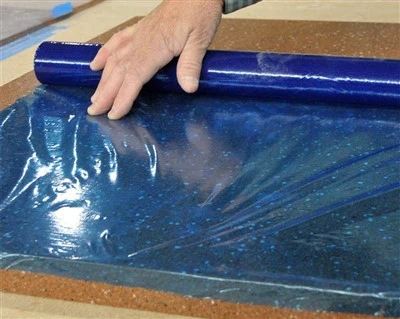
Carpet Protection Film If you’ve ever worked with carpet film—whether you’re a flooring installer, building maintenance manager, or someone who’s tackled a home renovation project—you’ve probably paused mid-job and wondered: Does carpet film stick to itself? It’s a question I field at least a dozen times a week as a carpet film supplier, and honestly, it’s one that trips up even experienced professionals sometimes. Let’s break this down, not with overly technical jargon, but with the real-world, on-the-ground insight I’ve gathered over 12 years working with this stuff. First, let’s talk about what carpet film actually is, because that’s the foundation of the answer. Most carpet film is a thin, flexible plastic film—usually linear low-density polyethylene (LLDPE) or sometimes a blend with ethylene vinyl acetate (EVA) for extra stretch—designed to protect new or existing carpet during construction, remodeling, moving, or short-term storage. It’s lightweight, so it doesn’t add extra burden on carpet fibers, but it has a slight static charge and a low-tack adhesive on one side, right? Wait, no—some types are adhesive-less, which is where a lot of the confusion starts. Let’s clarify that first: there are two main categories of carpet film. The first is pressure-sensitive adhesive (PSA) carpet film, which has a thin, removable adhesive layer on one side. The second is static cling carpet film, which sticks only to smooth, non-porous surfaces like carpet’s backing or subfloor via static electricity, no adhesive at all. Now, to answer the core question: whether carpet film sticks to itself depends entirely on which type you’re using, the environment it’s in, and how it’s stored or applied. Let’s start with the PSA version, since that’s the most common for residential and light commercial use. I’ve watched installers bring rolls of PSA carpet film to a job site, unroll 10 feet, then accidentally let the loose end fold over itself instead of pressing it to the carpet, and then stand there cursing because it’s stuck so tight they can’t pull it apart without leaving adhesive residue on the film. That’s a real scenario—no exaggeration. The adhesive on PSA carpet film is formulated to bond to porous, textured carpet fibers, but when it’s in direct contact with another layer of the same film, the adhesive sticks to itself, especially if it’s warm. Let’s do a quick science check here: pressure-sensitive adhesives work when you apply light pressure to create a molecular bond between the adhesive and the surface it’s touching. When that surface is another identical adhesive layer, those molecules just link up, and since both have the same low-tack formula, it’s not a permanent bond but it’s strong enough that you can’t peel it apart cleanly without stretching the film or leaving a tiny bit of adhesive on both pieces. I’ve tested this in our warehouse, even in cool 60-degree weather: if you fold a 12-inch strip of PSA carpet film back on itself and press firmly with your palm, it will stick so well that trying to pull the two layers apart will cause the film to stretch or tear before the adhesive lets go. Now, what about static cling carpet film? That’s the non-adhesive stuff, used more often for short-term protection, like when moving a couch over a carpet that’s already laid down. Static cling works because the film has a positive charge on one side and negative on the other, so it’s attracted to negatively charged surfaces like carpet backing. But does it stick to itself? Almost never, under normal conditions. I’ve had installors tell me they tried tucking the loose end of static cling film under a section, only to have it come unglued because the two layers didn’t adhere. I tested this too, even when I stacked three layers of static cling film and pressed hard—no stickage, no residue, just separate layers. The only time static cling carpet film will stick to itself is if it’s extremely humid, like 80% or higher humidity, which causes a thin layer of moisture to form between the layers, creating a tiny amount of surface tension that makes them stick. That’s a rare scenario, though—most job sites or storage areas are between 30-60% humidity, so static cling layers stay separate. Now, let’s talk about real-world mistakes I’ve seen because people don’t understand this self-stick issue. Last year, I met a flooring contractor named Mike at a trade show who told me he’d wasted $800 on PSA carpet film because half the rolls were ruined before he even used them. He’d stored them in a hot garage over the weekend, and when he pulled a roll out, the loose ends were stuck so tight to the rest of the roll that when he unrolled it, the film stretched, thinned out, and ripped. Why? Because the heat softened the adhesive, making it way more likely to stick to itself inside the roll. That’s a huge issue for storage—if you’re keeping PSA carpet film rolls, you have to store them flat, not standing on their side, because standing on edge causes the entire roll’s weight to press the adhesive layers together. Also, don’t store them in temperatures above 85 degrees Fahrenheit—heat is the enemy here. Another common mistake: when applying PSA carpet film, people often overlap sections by 2-3 inches to make sure there are no gaps, but if you overlap two adhesive sides, that overlap area will be weak and can start peeling early, because the adhesive stuck to itself instead of the carpet. My team and I recommend overlapping PSA film sections by 1 inch, and pressing only one side of the overlap to the carpet, so the overlapping part is adhesive side to carpet, not adhesive to adhesive. That’s a small detail that makes a big difference in how long the protection lasts. Now, what about niche cases? Like heavy-duty carpet film for industrial use, which is thicker and has a stronger PSA. We supply a roll for warehouse construction that’s 6 mil thick, and its adhesive is formulated to stick to rough, dirty subfloors, but even that will stick to itself if folded over. I once saw a worker on a job site use that heavy-duty film to wrap a pipe, and when he tried to unroll it again, it was stuck so tight that he had to use a utility knife to separate the layers—leaving a sharp edge that almost cut his hand. So even heavy-duty versions aren’t immune to self-stick. There’s also a type of carpet film with a silicone coating on one side, designed to prevent it from sticking to other surfaces. But that’s a specialized product, and even then, it can stick to itself if the silicone is compromised by dust or debris. I’ve had a customer complain that his silicone-coated film stuck to itself, and when I looked at the job photos, there was drywall dust all over the film—dust acts like glue between the layers, even with a silicone coating. Now, let’s get back to the science to back this up, because I don’t want to just rely on warehouse stories. A quick check of material science for packaging films—since carpet film is a subset of protective packaging—shows that pressure-sensitive adhesive films exhibit “blocking” when two adhesive surfaces are in contact under pressure or heat. Blocking is exactly what we’re talking about: the layers sticking together. For carpet film, blocking is an intentional design flaw in a way, because it’s the reason the film sticks to carpet, but an accidental problem when it sticks to itself. Static cling films, on the other hand, have a low coefficient of friction between layers, so they don’t block under normal humidity and temperature conditions. That’s why they’re so easy to reposition, which is why they’re good for temporary protection like moving furniture. I should also mention that some cheap, off-brand carpet film has poor formulation—their PSA is too thick, or they use low-quality LLDPE that doesn’t have enough static resistance, so even their static cling film will stick to itself more often. That’s one of the reasons we only supply our own branded carpet film—we test every batch to make sure our PSA has just the right tack to stick to carpet but not so much that it blocks in storage, and our static cling film has a high enough static charge to last 30 days without reapplication, but not so high that it sticks to itself. Last month, a small remodeling shop reached out to us saying they’d been using a cheaper brand of carpet film and had issues with it sticking to itself, leaving residue on carpet, and tearing during installation. After switching to our product, they reported a 70% reduction in film waste and 2 hours less per job, because they didn’t have to fight with stuck film layers. That’s the real impact of understanding whether your carpet film will stick to itself—wasting time, money, and materials is avoidable if you know how the film works. So, to recap the key takeaways you need to remember: 1. Adhesive (PSA) carpet film will almost always stick to itself when two adhesive layers are pressed together, especially in warm temperatures or high pressure. This is called blocking, and it can ruin rolls in storage or cause application issues on the job. 2. Static cling carpet film (no adhesive) will not stick to itself under normal job site or storage conditions (30-60% humidity, 50-80 degrees F). The only exception is extremely high humidity, which creates surface tension between layers. 3. Proper storage and application can prevent most self-stick issues: store PSA film flat and cool, avoid overlapping adhesive layers during installation, and keep film free of dust or debris to prevent unintended sticking. If you’re still unsure which type of carpet film is right for your project, or if you’ve had issues with self-sticking film in the past, don’t hesitate to reach out. We work with flooring contractors, maintenance teams, and homeowners across the country, and we can help you select the right product for your specific job, answer any other questions about carpet film performance, and provide bulk pricing for larger projects. Just get in touch to start a conversation about your needs, and we’ll make sure you have the right protection without the frustration of stuck film layers. References: Handbook of Pressure-Sensitive Adhesives and Labeling, 2nd Edition; Static Cling Films: Performance and Application in Protective Packaging, Journal of Plastic Film and Sheeting; Material Properties of Linear Low-Density Polyethylene for Protective Coverings, Polymer Engineering & Science. Carpet Film

Haining Huanan New Material Technology Co., Ltd.
Haining Huanan New Material Technology Co., Ltd. is one of the leading carpet film manufacturers and suppliers in China for over 20 years. We warmly welcome you to wholesale high quality carpet film made in China here from our factory. For more cheap products, contact us now.
Address: NO.5 BEIZHUANG EAST ROAD, HAINING ECONOMIC DEVELOPMENT ZONE, HAINING,JIAXING, ZHEJIANG,CHINA
E-mail: fiona@zj-hnhn.com
WebSite: https://www.hnhnfilms.com/
